I first began appreciating the art of sound as a child. I didn’t know it at the time, but my “view” of the world was influenced by synesthesia, so experiencing more than one sense simultaneously, for a single stimulus was something I took for granted. I recall teachers kindly correcting my choice of words, when I said things like “my jumper is noisy” (from its texture), or “because it tastes nice”, in response to “why did you paint that bird yellow?”. I unknowingly remapped my vocabulary over time, still thinking everyone saw the world this way, but adopting a common lexicon.
My career path kept me in a world somehow related to audio. As a linguist, I participated in some brief testing of a very early manual voice identification gizmo that displayed a spectrogram. “Neat”, I thought. By the time I was leading research in audio exploitation years later, modern computing power had made so many more analysis techniques possible. Part of my daily routine was to analyze spectrograms, waveforms, and various other data projections of sound. I rotated printouts of them on my old-school corkboard and soon found myself appreciating the intrinsic beauty of what is essentially a sound “fingerprint”.
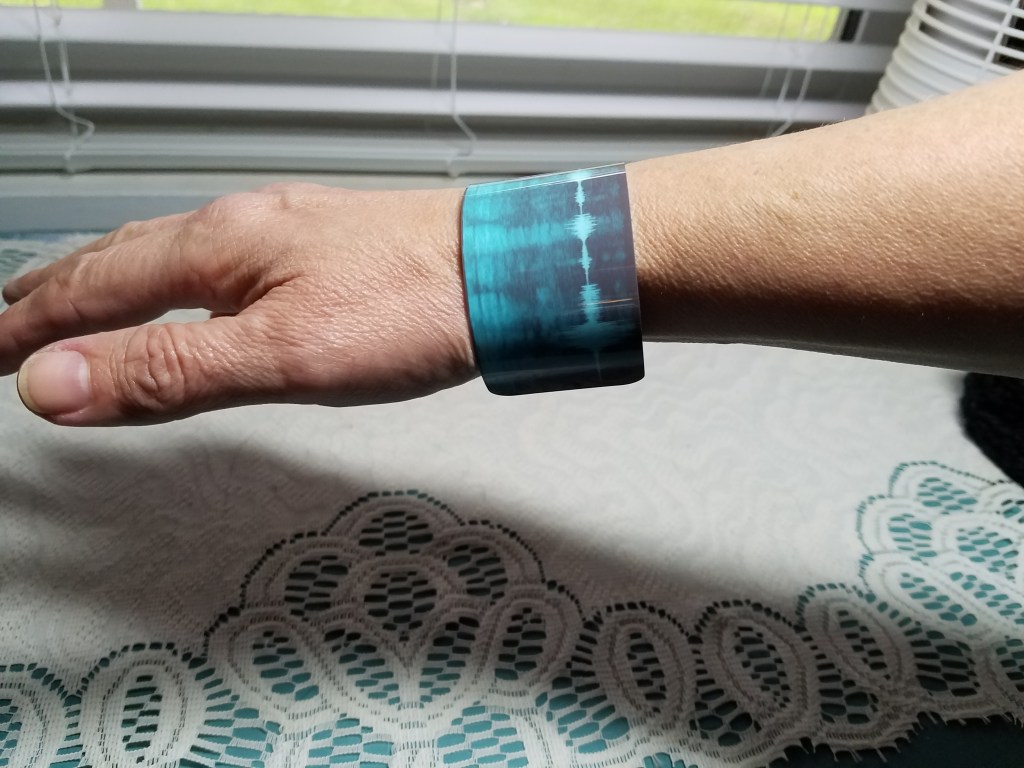
My team and I built a repository of voice samples from many sources, to include interns. At the end of their time with us, I would print and frame a spectrogram of their voice as a momento. This quickly morphed into a new hobby for myself – creating art from sound. Merging a spectrogram, which shows the “shape” of the sound over time, with its corresponding waveform, which shows things like pitch and volume, into a stylized image is a relatively simple process. Coloring each element in a meaningful way and layering everything together into one image brings me joy. Sound Shadows, I call them (though that’s actually a term for a specific audio phenomenon, also known as an acoustic shadow, but I digress).
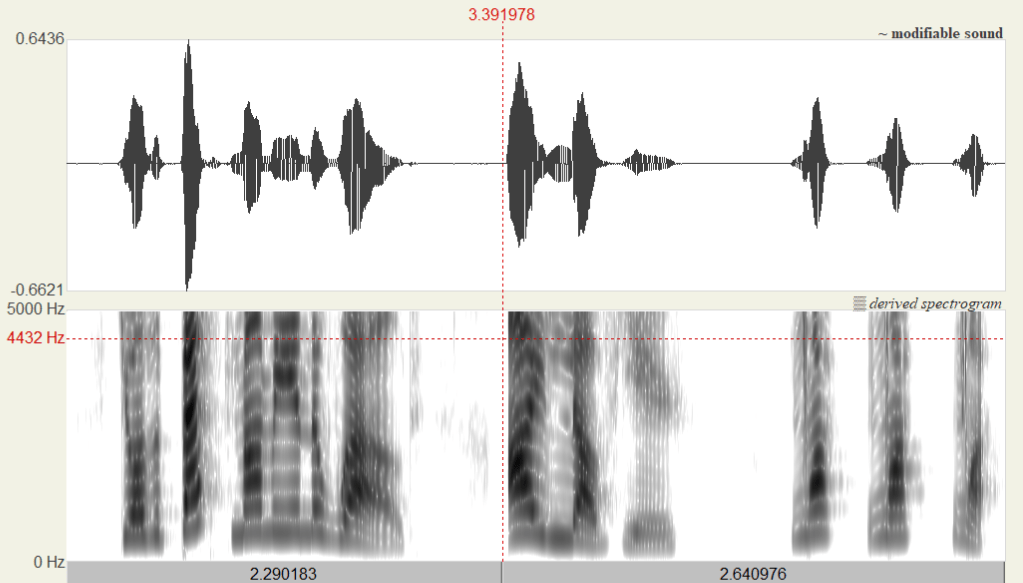
I dabbled for a few years selling Sound Shadows, creating bespoke art I sold online. An art piece to hang on the wall or wear, along with a link to a spectrogram video. Customer voice sounds such as a baby’s cry, a child’s first phrase, a dog’s bark, a loved one’s final voice mail became works of passion for me, knowing they were going to tease a few tears. A few musicians recorded their favorite pieces, such as when they completed their exams. Fetal heartbeats were cool. The view of a freshly-tuned motor cycle engine was fascinating. But sounds from nature are probably my favorites. A loon’s mournful call, frogs in my pond, morning birdsong.
I still make my Sound Shadows for fun, plus the occasional gift, and I’m pleased with the high-resolution renderings I’m able to create. I wonder sometimes about connecting with a musician to explore creating novel music art and merch. This kind of techno-art isn’t for everyone, but it’s a wonderful reason for me to get out and collect sounds and then hunker down to tinker and create. Besides, the technologist in me loves explaining things and these sound visualizations make it a little easier to share how I perceive the world.
 Fuz Eller